












Shipping Eco-Friendly Gold Leaching Agent to Uzbekistan: What Actually Matters After the Sample Stage
-
Company News
-
 2026-10-22
-
 盈彩新材料Ying cai

One detail that’s easy to overlook.
Supplying an eco-friendly gold leaching agent to mines in Uzbekistan on a long-term basis is a completely different game from shipping one or two containers of samples. At the sample stage, the only question is “can it leach the gold out.” Long-term supply is about a different set of things: whether batch No. 50 dissolves at the same speed as batch No. 3, whether the reagent cakes up after two weeks in a container under the Navoi summer sun, and whether the people in the leach plant need to relearn a whole set of operating procedures on the day the mine switches reagents.
Uzbekistan’s gold sector is not small. Navoi Mining and Metallurgical Company (NMMC) is one of the world’s major gold producers. In 2025 it produced about 118.4 tonnes of gold. In the first half of 2026 output dipped slightly, but the full-year target is 120 tonnes, and longer term it is looking at an expansion plan eyeing 1.75 million tonnes by 2030. The Muruntau open pit has resources of more than 100 million ounces, and both heap leaching and carbon-in-pulp circuits are running there. For a mine of that size, reagent procurement is not “buy again when we run out.” It is a fixed variable in the production schedule. If one batch goes wrong, the loss is not the cost of a few bags of reagent. It is a leaching cycle pushed back, pregnant solution grade dropping, and the monthly metal balance sheet not reconciling.
That is the real technical problem that “long-term shipping” has to solve.
The context for eco-friendly gold leaching agents in Uzbekistan is a bit different from China
In China, when people talk about eco-friendly gold leaching agents, the conversation inevitably runs into sodium cyanide’s hazardous chemicals controls: transport permits, dedicated storage warehouses, and tailings characterization that can turn into hazardous waste if you are not careful. Those pain points are real. But for mines in Uzbekistan, the more immediate push is coming from another direction — financing and audits.
In recent years NMMC has been moving toward compliance with the International Responsible Gold Mining Principles and the International Cyanide Management Code. The schedule audit SRK helped it with is tied to hard requirements from international lenders. Whether a mine uses a non-cyanide reagent is one thing. But across the whole reagent chain, traceability, batch consistency, and completeness of safety data documentation are items that cannot be avoided in an audit. An eco-friendly gold leaching agent that keeps a retention sample from every batch, has factory test records for dissolution speed, and is clearly labeled in its packaging is far more useful in due diligence documents than the sentence “we are very green.”
On the other hand, Uzbekistan’s mines are not only NMMC. There are a large number of medium-sized and small-to-medium mining sites and tailings reprocessing projects that do not have NMMC’s supporting cyanide management team and disposal facilities. For them, moving the reagent down from the “high-risk controlled category” releases management bandwidth in itself.
The reagent itself: what a chelation system can do, and what it cannot
Yingcai’s YCA02003S follows a composite organic chelating/complexing route. It contains no cyanide radical. It is a solid powder, dissolves in clean water at ambient temperature, and is maintained at pH 10.5–11.5, adjusted with lime or caustic soda. Process compatibility is one of its most practical points: existing equipment for heap leaching, vat leaching, and carbon-in-pulp does not need major changes. The operating logic runs basically parallel to a cyanide system. The cost of switching for operators is not in the equipment; it is in fine-tuning parameters.
At the leaching mechanism level, the core of a non-cyanide chelation system is the coordination chemistry that “pulls” gold from the ore into solution. It differs from the pathway in which the cyanide ligand lowers the reduction potential of Au⁺. But for oxide ore, low-grade tailings, roasted slag, and similar materials, recovery can get close to cyanide levels under equivalent process conditions, and some low-grade samples even come out slightly ahead. But to be clear: not every ore is a plug-and-play fit. For complex ores with high sulfur, carbon, or arsenic, the chelation system’s interference resistance has limits. Recovery can only be held steady by using conditioning additives or adjusting the leaching regime. That is why a small lab test on each ore sample to set reagent unit consumption and the pH window cannot be skipped. In a long-term supply contract, building “ore sample bench test — parameter lock — batch retention sample comparison” into the process is more solid than any promotional language.
The few things that really need attention in long-term shipping
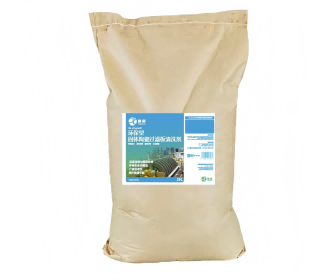
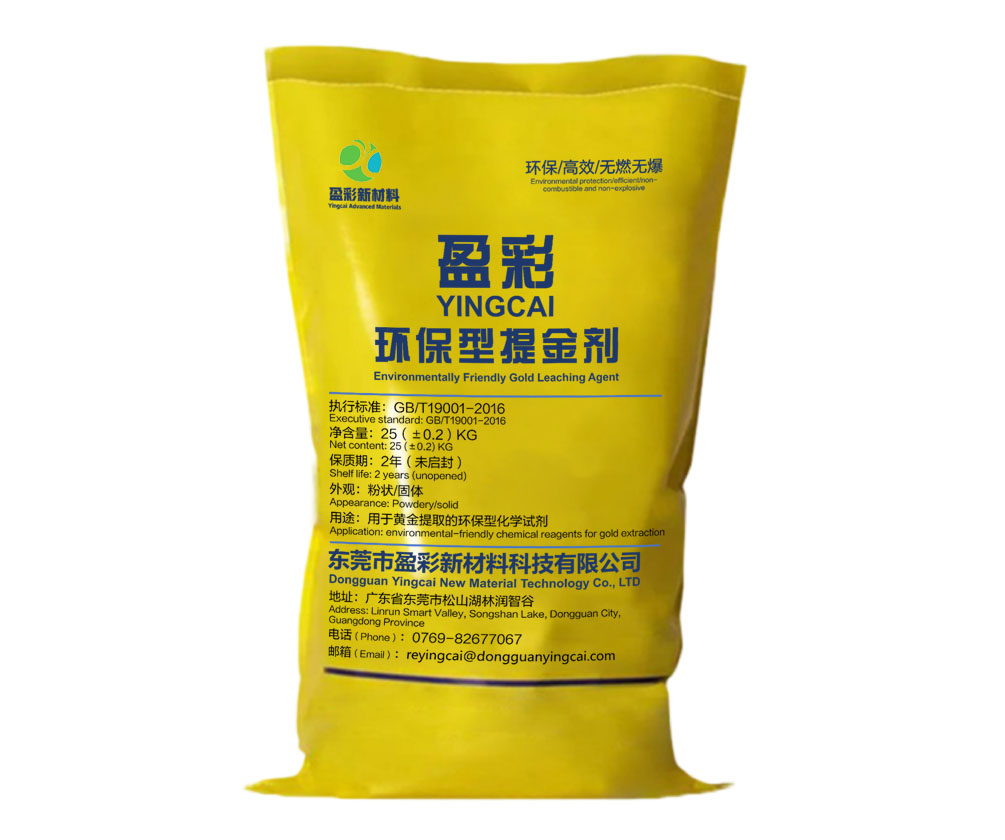
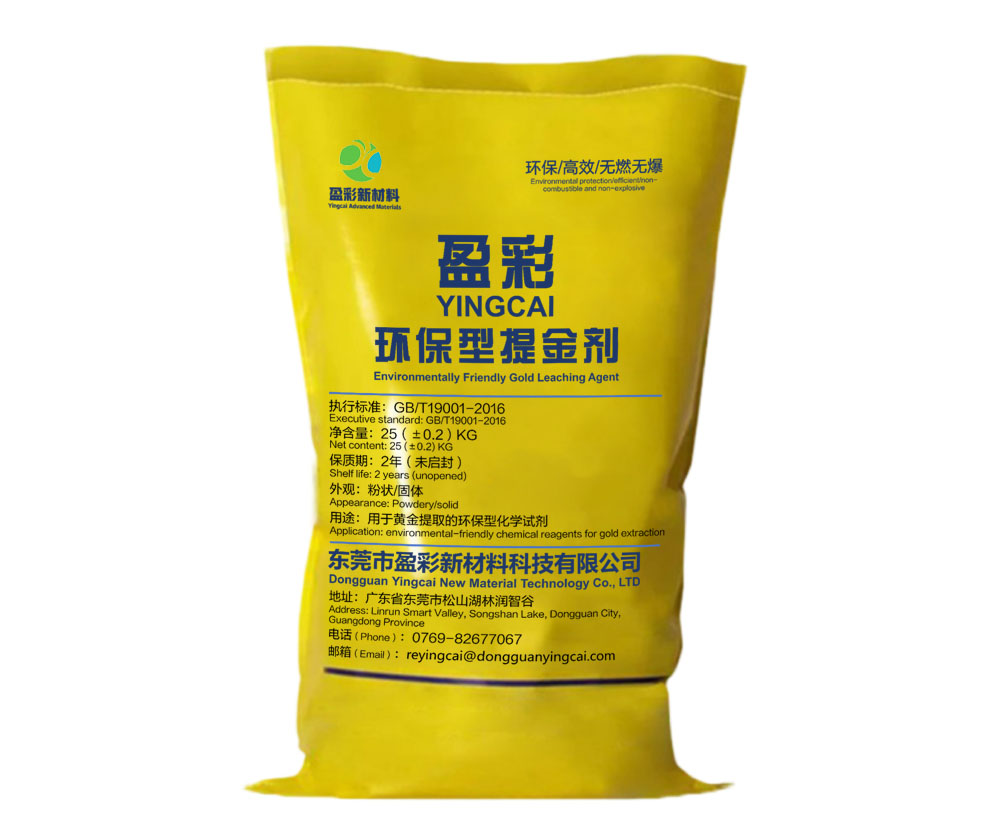
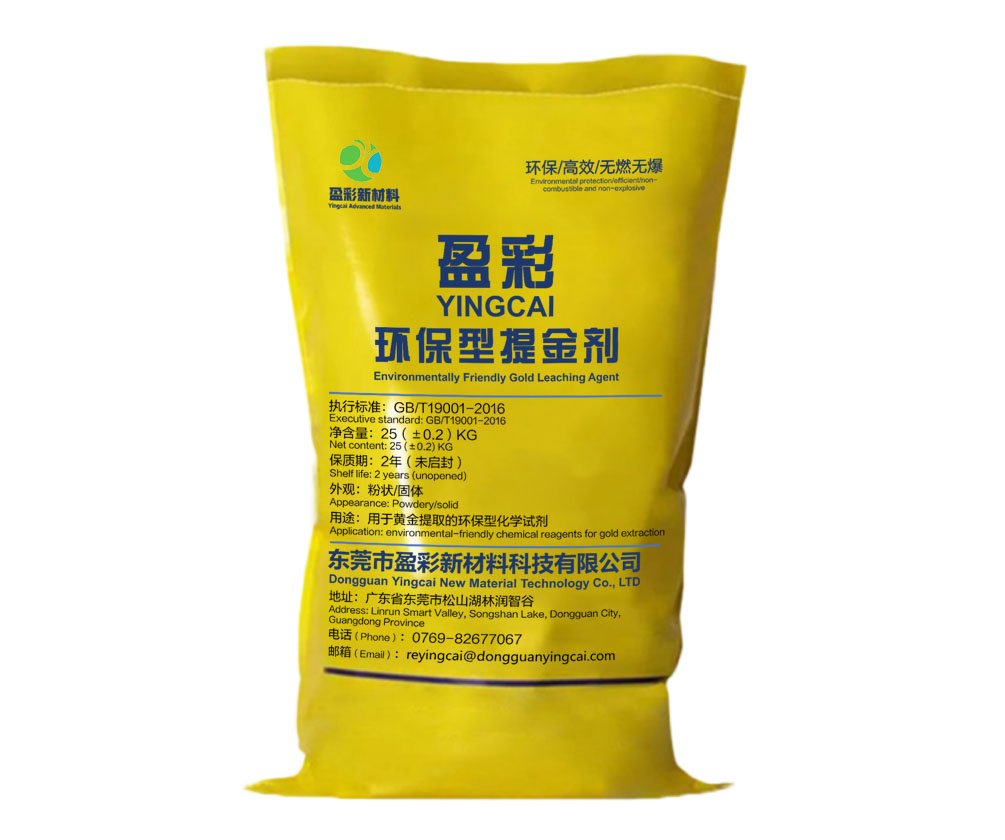
Packaging and shelf life. 25 kg woven bags with an inner PE liner. Under sealed, dry conditions, shelf life is 24 months. This specification matches the on-site storage conditions in Uzbekistan: stacked in an ordinary warehouse, no explosion-proof room needed, no dedicated duty ledger. Cross-border transport goes through general chemical goods channels, so there is far less schedule uncertainty than with the special procedures for cyanide.
Batch consistency. The thing a mine in continuous production fears most is “this batch dissolves fast, the next batch dissolves slowly, and the leaching curve no longer matches.” Yingcai controls from full inspection of incoming raw materials to staged synthesis control, and before finished product leaves the factory it runs dissolution speed, leaching compatibility, and simple wastewater degradation tests. Retention samples from every batch are traceable. This is not flashy, but trust in long-term supply is built exactly this way. A leach plant supervisor in Navoi does not care how beautiful your lab data is. He only cares whether the container that arrives next month is the same thing as the container that arrived last month.
The rhythm of cross-border technical response. There is a time difference between Uzbekistan and China. When a mine is adjusting pH on site or sees pregnant solution grade fluctuating, it cannot wait three days for an email to go back and forth. A more practical approach in long-term cooperation is this: each shipped batch comes with reference dissolution curve data for that batch, and the site runs according to the agreed parameters. When there is a deviation, first run a parallel bench test with the retention sample, narrow the variable down to “the ore changed” or “the operation changed,” and then decide whether the reagent regime needs adjustment. This process is not complicated, but it needs to be aligned with the mine before the first batch ships, not patched together after a problem shows up.
In the end, when an eco-friendly gold leaching agent goes overseas to Uzbekistan, the technical narrative should not stop at the slogan “non-toxic replacement for sodium cyanide.” NMMC is expanding production and moving toward international compliance standards. Medium-sized mining sites are looking for a lighter management burden. These are the real rhythms of the industry. A reagent can get in because of batch stability, a simple process interface, and safety documentation that stands up to scrutiny — not because of the phrase “green and eco-friendly.”
Long-term shipping is essentially about using the certainty of the supply chain to hedge against the uncertainty of mine production. The reagent is only one link in that chain.
Share


